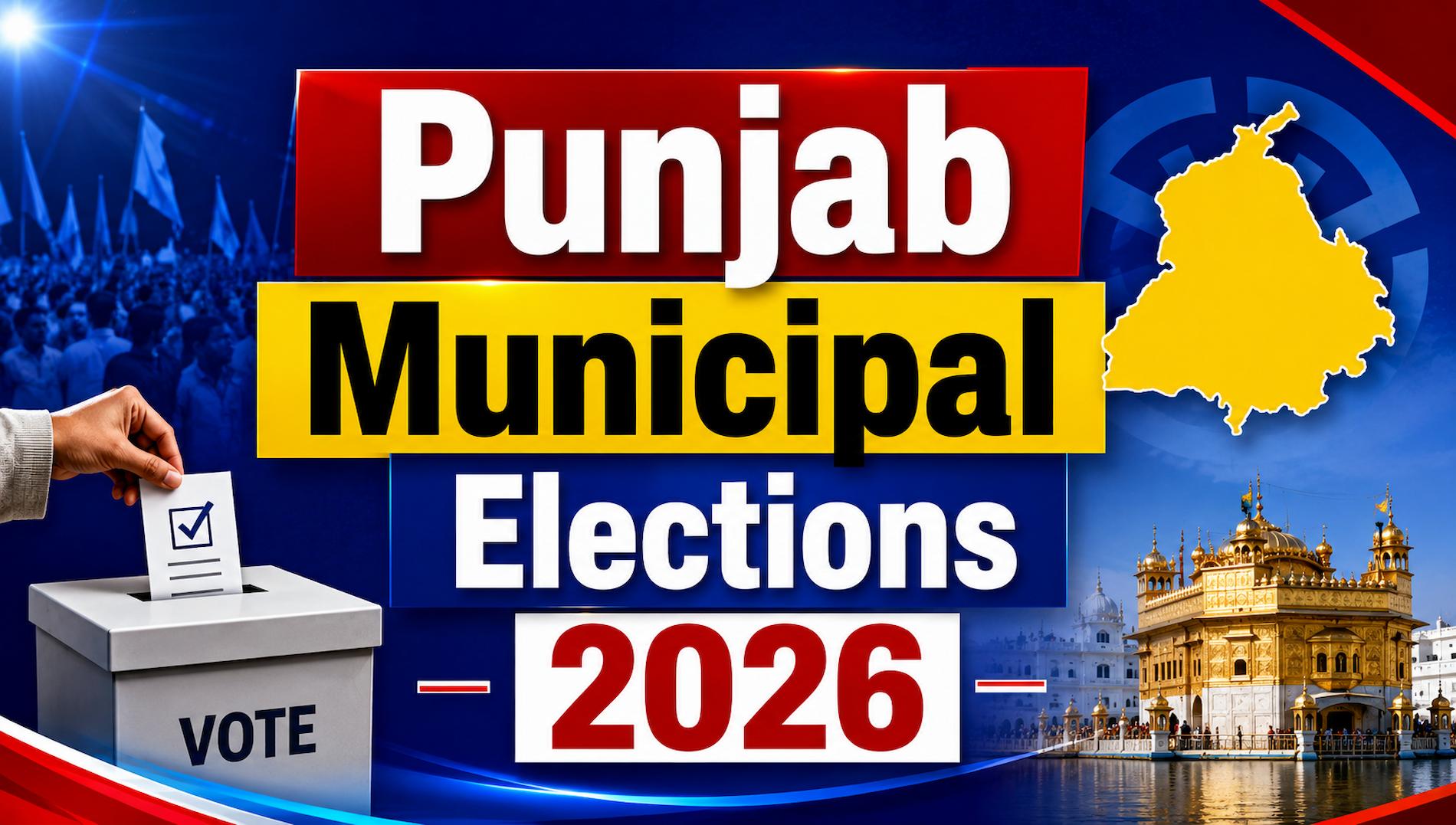
The Punjab Municipal Elections 2026 are set to become the state’s biggest urban democratic exercise before the 2027 Assembly battle. With voting across 105 urban local bodies on May 26, over 36 lakh voters, major party rivalries, and high political stakes, Punjab’s civic polls are shaping into a crucial governance referendum.
Overview
The Punjab Municipal Elections 2026 officially entered the political spotlight after the Punjab State Election Commission announced on May 11, 2026, that elections for 105 urban local bodies would take place on May 26. Covering eight municipal corporations, 76 municipal councils, and 21 Nagar Panchayats, this large-scale civic exercise is being viewed as a political semi-final before the 2027 Punjab Assembly elections. Polling will run from 8:00 AM to 5:00 PM, with counting on May 29. More than 36.72 lakh voters will decide the future of 2,019 wards across Punjab’s urban centers. For the ruling Aam Aadmi Party, these polls test governance promises. For Congress, the BJP, and the Shiromani Akali Dal, they offer a major opportunity to reshape urban political equations and reclaim lost ground.
Key Takeaways
- Polling date: May 26, 2026
- Counting date: May 29, 2026
- Nomination filing: May 13–16, 2026
- Scrutiny of nominations: May 18, 2026
- Withdrawal deadline: May 19, 2026
- Total urban local bodies: 105
- Municipal corporations: 8
- Municipal councils: 76
- Nagar Panchayats: 21
- Total wards: 2,019
- Registered voters: 36,72,932
- Women voters: 17,73,716
- Polling stations: 3,977
- Election staff: Around 36,000
Punjab Urban Local Body Polls 2026: Election Timeline and Schedule
The Punjab urban local body polls 2026 are unfolding on a tightly monitored administrative schedule.
The notification triggered the immediate implementation of the Model Code of Conduct across Punjab.
Complete Election Calendar
- Notification: May 11
- Nominations: May 13–16
- Scrutiny: May 18
- Withdrawal: May 19
- Voting: May 26
- Counting: May 29
This framework reflects one of Punjab’s most expansive urban electoral operations in recent years.
Punjab Municipal Election 2026: Scale of the Urban Contest
The 2026 Punjab municipal election covers a broad municipal structure across cities, councils, and Nagar Panchayats.
Bodies Going to Polls
- 8 Municipal Corporations
- 76 Municipal Councils
- 21 Nagar Panchayats
This means 102 urban local bodies and 2,019 wards will determine the direction of city governance.
Municipal Corporations in Focus: Key Urban Battlegrounds
The eight major municipal corporations represent Punjab’s most politically sensitive urban centers.
Major Corporations
- Mohali (SAS Nagar)
- Bathinda
- Abohar
- Barnala
- Kapurthala
- Moga
- Batala
- Pathankot
These cities are likely to become the primary battlegrounds for AAP, Congress, BJP, and SAD.
Punjab Voting Date and Voter Strength
The Punjab voting date of May 26 will activate one of the largest urban voter pools in the state’s history.
Electorate Data
- Total voters: 36,72,932
- Women voters: 17,73,716
- Polling stations: 3,977
The voter scale underlines how significant these civic polls are for urban governance legitimacy.
Major Urban Issues Driving Campaigns
- Water supply
- Sewage and sanitation
- Urban infrastructure
- Corruption allegations
- Municipal accountability
- Road quality
- City planning
Punjab Nagar Panchayat Elections: Local Governance at the Grassroots
The Punjab Nagar Panchayat elections are equally important because smaller towns often shape broader regional political sentiment.
These local contests frequently reveal voter mood shifts before larger state elections.
Nagar Panchayat results may especially influence narratives around development delivery in semi-urban Punjab and future of the politicians.
Punjab Election Commission: Security and Administrative Oversight
The Punjab Election Commission has planned a large security and governance framework.
Administrative Measures
- 35,000+ police personnel
- 36,000 election staff
- IAS/PCS district observers
- Candidate KYC disclosures
- Public affidavit uploads
This system is designed to maximize transparency and reduce malpractice risks.
Candidate Spending Rules and Election Monitoring
Financial regulations will also shape campaign strategy.
Spending Limits
- Municipal Corporation candidates: Up to ₹4 lakh
- Municipal Council/Nagar Panchayat candidates: Lower limits starting around ₹1.4 lakh
These caps are intended to create more balanced competition.
Political Parties and Stakes: Punjab’s Semi-Final Before 2027
The role of major Political parties makes this election especially important.
AAP
- Ruling state party
- Faces governance referendum
- Urban performance under scrutiny
Congress
- Led by Amrinder Singh Raja Warring
- Seeks anti-incumbency gains
BJP
- Pursuing urban expansion
SAD
- Fighting for revival
Political Stakes for Major Parties
- AAP: Governance validation
- Congress: Organizational revival
- BJP: Urban expansion strategy
- SAD: Political survival
- Independents: Ward-level disruption
Punjab Political News: Why These Polls Matter Beyond Municipal Governance
Current Punjab political news positions these elections as more than city administration contests.
They are widely seen as the first major urban political test before the 2027 Punjab Assembly election.
A strong AAP showing could validate governance. Congress gains may indicate anti-incumbency. BJP growth could signal changing urban loyalties. SAD’s performance will test its relevance.
Punjab Municipal Council Elections and Delayed Zones
The Punjab municipal council elections will proceed broadly, though Hoshiarpur and Sham Chaurasi could face delays due to reservation and electoral roll issues.
This reflects how technical electoral administration can influence political timelines.
Punjab Local Elections Update: Administrative Background
Recent appointments of administrators to multiple civic bodies had already signaled the urgency of formal elections.
Now, with the official schedule in place, Punjab’s urban electorate will directly determine future city governance structures.
Punjab Election Schedule 2026 and Broader Democratic Significance
The Punjab election schedule 2026 demonstrates the state’s shift into a politically charged urban cycle.
These elections may shape:
- Municipal governance
- Party momentum
- Urban voter behavior
- 2027 Assembly narratives
Strategic National and Regional Relevance
Punjab’s urban political landscape has national implications because city-level outcomes often influence broader state narratives.
For national parties, especially BJP, Punjab offers strategic expansion opportunities. For regional forces, civic outcomes may redefine survival and future coalition strategies.
Conclusion
Punjab’s upcoming civic elections are set to become a defining political milestone, blending governance accountability with strategic electoral competition. With millions voting across hundreds of wards, these polls will not only shape municipal leadership but also reveal Punjab’s evolving political mood ahead of larger state battles.