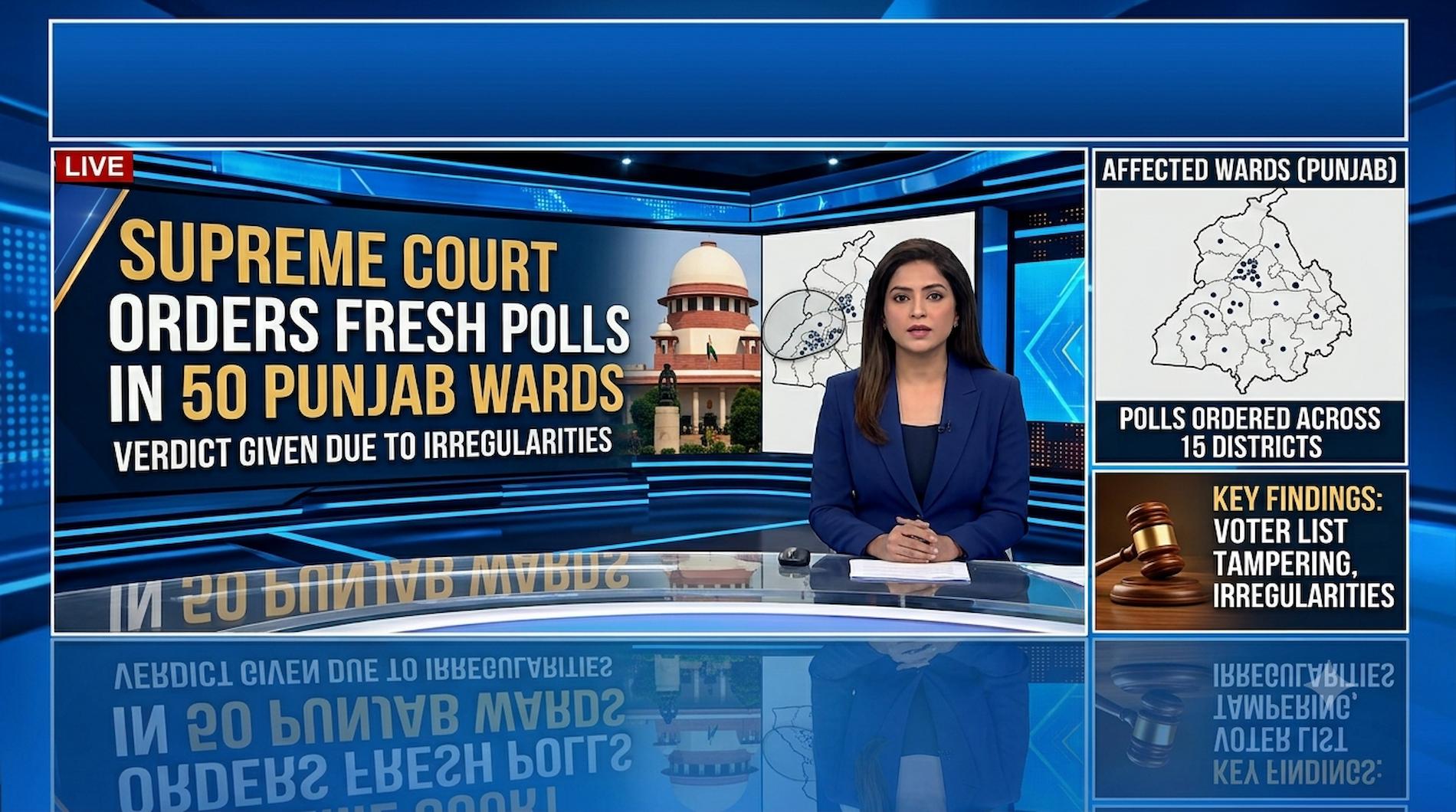
Supreme Court Orders Fresh Polls in 50 Punjab Wards
Punjab’s municipal election controversy has reached a decisive turning point after the Supreme Court ordered fresh elections in 50 wards across Patiala and Moga districts. The September 28, 2026, ruling follows findings of serious irregularities during the December 2024 nomination process. With judicial monitoring, mandatory videography, and a six-week deadline, the rerun could influence local political equations ahead of Punjab 2027 Assembly elections.
Key Facts
- Supreme Court ruling: On September 28, 2026, the Supreme Court of India set aside elections in 50 Punjab municipal wards and ordered fresh polling within six weeks.
- Patiala district: The order covers 28 of the Patiala Municipal Corporation’s 60 wards. Previous results in these affected wards included 25 AAP wins, two BJP wins, and one Congress win.
- Moga district: The ruling covers all 15 wards of Baghapurana Municipal Council and seven of Dharamkot Municipal Council, affecting 22 wards in total.
- Fact-finding inquiry: The court appointed former Punjab and Haryana High Court judge Justice Nirmaljit Kaur on March 24, 2025. Her commission submitted its report on November 18, 2025.
- Election safeguards: A monitoring committee headed by a retired High Court judge, independent observers, and videography of key election stages will oversee the fresh process.
- Political significance: The ruling sets up a fresh electoral test for the Aam Aadmi Party (AAP), Congress, Bharatiya Janata Party (BJP), and Shiromani Akali Dal (SAD) ahead of the Punjab Assembly elections scheduled for 2027.
The Supreme Court’s decision to annul 50 municipal ward elections has put Punjab’s local democratic process under renewed scrutiny. The order, issued on September 28, 2026, directs authorities to conduct fresh elections within six weeks after a fact-finding commission identified serious problems involving candidate nominations and electoral fairness.
The ruling, reported publicly on October 7 and 8, raises questions about opposition participation, election administration, and the responsibility of public officials. Supreme Court orders fresh elections in 50 Punjab wards is now a significant development in the state’s political debate, with consequences for local representation and public confidence in the electoral system.
Why the Supreme Court Ordered Fresh Elections
Patiala and Moga: The 50-Ward Breakdown
The court’s order covers 28 wards in Patiala district and 22 in Moga district. It accepted the recommendations of a commission that examined complaints relating to the December 21, 2024, municipal elections.
| Municipal area | Wards affected |
|---|---|
| Patiala Municipal Corporation | 28 of 60 |
| Baghapurana Municipal Council | All 15 |
| Dharamkot Municipal Council | 7 of 13 |
| Total | 50 |
The Patiala results in the affected wards had favored AAP, which won 25 seats, while the BJP won two and Congress one. These are the previous results, not the outcome of the upcoming fresh elections.
The decision also affects local representation in Baghapurana and Dharamkot. Residents in these wards will have another opportunity to participate in elections conducted under the safeguards specified by the court.
What the Fact-Finding Commission Discovered
On March 24, 2025, the Supreme Court appointed Justice Nirmaljit Kaur, a former Punjab and Haryana High Court judge, to investigate disputed election proceedings. The commission submitted its report on November 18, 2025.
According to the findings recorded in the court’s September 28 order, the inquiry examined 46 claim petitions submitted by 85 claimants. Four petitions were withdrawn, while two were rejected as not maintainable. The commission considered affidavits, official responses, photographs, videos, CCTV footage, voter records, and statements from election officials, police personnel, and claimants.
The commission identified serious interference with the nomination process, including instances in which opposition candidates were allegedly prevented from submitting their papers. Other reported incidents involved nomination documents being snatched, torn, or destroyed, as well as candidates facing threats, assault, detention, or pressure to withdraw.
The inquiry also identified evidence of alleged bogus or multiple voting and intimidation in two Patiala wards. However, not every allegation was established. The commission found insufficient evidence to substantiate some complaints, demonstrating why its conclusions must be understood ward by ward rather than as proof that every reported irregularity occurred everywhere.
How the 2024 Civic Polls Became a Legal Dispute
Opposition Candidates Challenge the Process
The December 21, 2024, elections became the subject of legal challenges after candidates alleged that they had been obstructed from contesting. Their complaints raised concerns about access to nomination offices, the handling of election documents, police conduct, and compliance with directions for recording the nomination process.
The dispute became particularly consequential because nomination procedures determine who can compete before voters cast their ballots. If eligible candidates are prevented from filing valid nominations, voters may lose the opportunity to choose among competing candidates.
The commission also examined concerns about the availability of CCTV recordings and the documentation of disputed incidents. These issues reinforced the importance of preserving evidence so that complaints can be assessed objectively.
The State Government’s Position
The Supreme Court bench comprised Chief Justice of India Surya Kant and Justices Joymalya Bagchi and V. Mohana. During the proceedings, senior advocate Kapil Sibal, representing the Punjab government, stated that the state had no objection to accepting the commission’s recommendations.
The court subsequently accepted the findings concerning the 50 wards and directed fresh elections. The order applies to the affected wards in this particular case; it does not automatically invalidate elections elsewhere in Punjab or establish that every allegation against an individual or political party was proven.
Judicial Monitoring and Election Safeguards
The court has prescribed additional safeguards to improve transparency and prevent similar disputes during the fresh election process. Supreme Court orders fresh elections in 50 Punjab wards with a clear emphasis on independent oversight and documented procedures.
The Chief Justice of the Punjab and Haryana High Court was requested to constitute a monitoring committee headed by a retired High Court judge within one week. The High Court Chief Justice was also asked to nominate two or three senior members of the High Court Bar as observers.
The principal safeguards include:
- Six-week deadline: The fresh election process must be completed within six weeks of the September 28, 2026, order.
- Videography: Nomination filing, scrutiny, submission of documents, symbol allocation, polling, and other specified stages must be recorded in the presence of the observers.
- Independent supervision: The monitoring committee will oversee the process from notification through declaration of results.
- Official accountability: The Punjab government must provide ward-wise details of election-duty officials and police officers of deputy superintendent of police rank and above.
- Preservation of evidence: Recordings must be preserved and handed over to the monitoring committee.
- Conditions for results: Results are not to be declared until the High Court Chief Justice is satisfied, on the basis of the committee’s report, that the elections were conducted freely and fairly.
These requirements make oversight an essential part of the rerun rather than an exercise limited to investigating the previous elections.
Political Reactions and Implications
AAP, Congress, BJP, and SAD Face a Fresh Test
The ruling has created a new political challenge for the AAP Punjab government led by Chief Minister Bhagwant Mann. Because AAP candidates won 25 of the 28 affected Patiala wards in the previous results, the fresh elections could alter the balance of representation. Those earlier victories have been set aside in the affected wards, and the new results remain unknown.
Congress has welcomed the fresh-election order. Senior Congress leader Mohit Mohindra has presented the decision as an important test of electoral fairness. The party may use the rerun to strengthen its local campaign and question the conduct of the previous polls.
The BJP has also raised allegations of obstruction during nominations. Patiala BJP district president Vijay Kuka and other party representatives have criticized the alleged interference. The Shiromani Akali Dal has likewise complained about obstacles faced by its candidates and called for accountability.
These political responses should be distinguished from the court’s specific findings. The ruling addresses the validity of elections in the affected wards; it does not, by itself, establish criminal liability for every person accused by a political party.
What Voters Should Watch
The fresh polls will test whether stronger supervision can restore confidence in the electoral process. Residents should pay attention to official election notifications, nomination deadlines, candidate lists, polling arrangements, and instructions issued by the relevant election authorities.
The Punjab municipal elections 2026 dispute also raises broader questions about how election officials respond to complaints and preserve evidence. Transparent nomination procedures, impartial law enforcement, and accessible complaint mechanisms are essential to ensuring that eligible candidates can compete fairly.
The political consequences may extend toward the Punjab Assembly elections 2027. Congress, BJP, and SAD may use the controversy to challenge the ruling party’s record, while AAP will have an opportunity to defend its local support. However, the outcome will depend on voter choices, campaign organization, local issues, and the credibility of the new election process.
The Road Ahead
The fresh elections offer an opportunity to correct the commission’s identified failures and reaffirm the importance of fair competition. Their credibility will depend on whether nomination procedures are properly documented, officials perform their duties impartially, and complaints receive timely attention.
For residents, the immediate concern is straightforward: every eligible candidate must have a fair opportunity to contest, and every eligible voter must be able to cast a ballot without intimidation. The final test will be whether the new process delivers legitimate representation and strengthens confidence in Punjab’s municipal institutions.