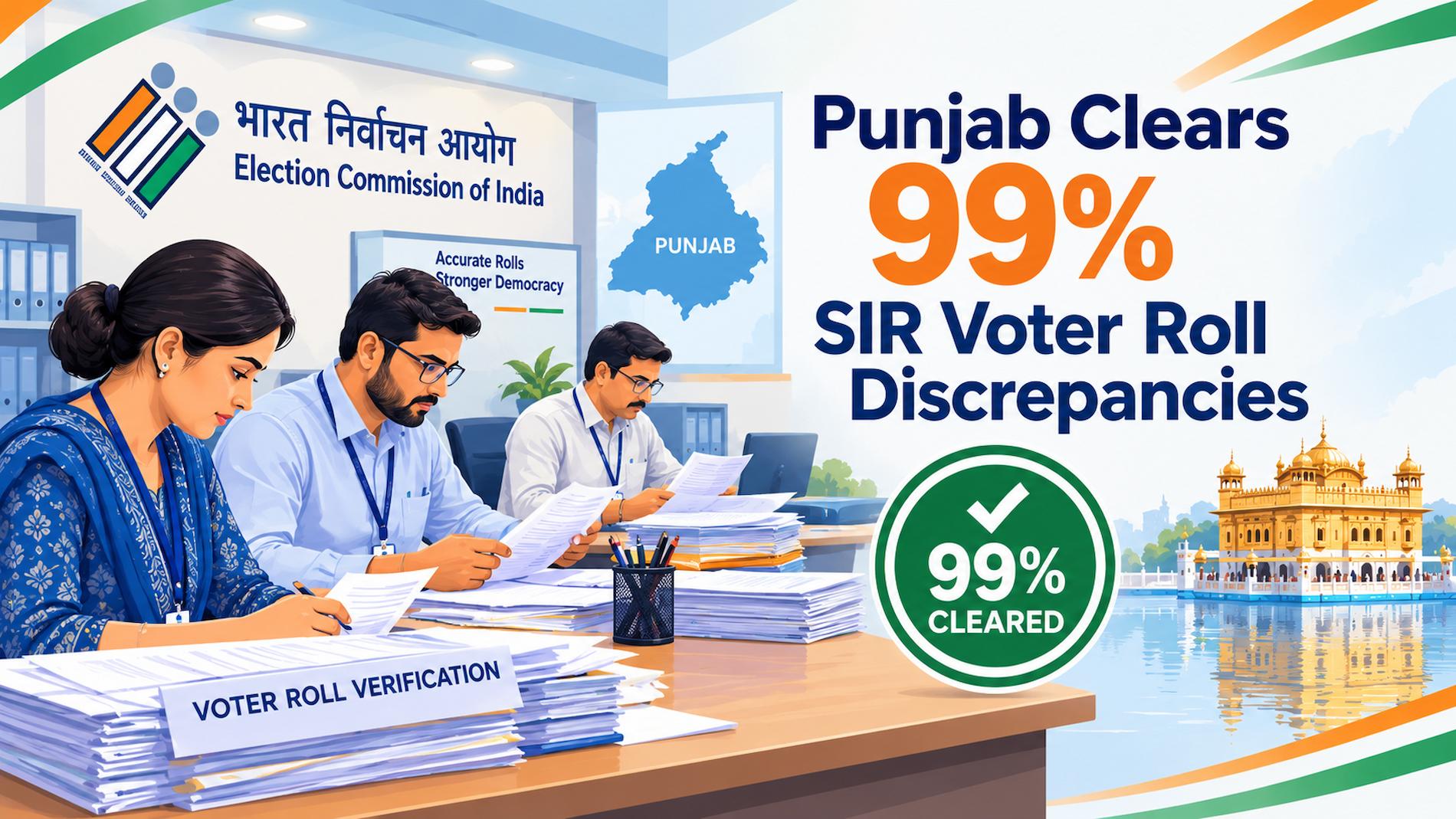
Punjab Clears 99% of SIR Voter Discrepancies
Punjab has resolved 22.41 lakh of 22.69 lakh logical discrepancy cases identified during the 2026 voter-roll revision. With 98.77% of flagged records addressed, election officials are working to settle the remaining cases before October 8, ahead of the final electoral roll scheduled for publication on October 12.
Punjab’s Punjab SIR 2026 exercise has reached a significant stage, with officials reporting that 22.41 lakh of the 22.69 lakh electors flagged for logical discrepancies have been cleared. The figure represents 98.77% of the cases identified during the revision of the state’s electoral records. The latest update, reported on September 23, 2026, leaves around 27,700 cases pending before the final roll is scheduled for publication on October 12.
The development is important because the Punjab Special Intensive Revision involves a large-scale verification of electoral records across the state’s 117 Assembly constituencies. The exercise has also generated political discussion, making accurate distinctions between different categories of voter-roll cases particularly important.
It is also worth clarifying that the phrase Rajya Sabha MLC elections 2026 may appear in some election-related searches, but it does not describe Punjab’s SIR process. SIR is a voter-roll revision exercise conducted by the Election Commission of India, not an election for Rajya Sabha or state Legislative Council members.
Takeaway: Six Key Points
- 22.41 lakh cases cleared: Punjab has addressed 22.41 lakh of the 22.69 lakh electors whose enumeration forms were flagged for logical discrepancies, representing 98.77% of cases.
- 27,700 cases remain: Electoral staff have until October 8 to decide the remaining cases using documents submitted by voters, hearings and Booth Level Officer undertakings.
- Final roll on October 12: The Punjab electoral roll 2026 is scheduled to be published as the final electoral roll on October 12, following disposal of pending cases.
- 117 Assembly constituencies: The house-to-house enumeration exercise covered all 117 Punjab Assembly constituencies, with more than 1.93 crore electors submitting enumeration forms.
- Political context: BJP leader Raghav Chadha, elected as an AAP Rajya Sabha nominee in 2022 and joining the BJP in April 2026, alleged a political vendetta after his name was classified as “permanently shifted.” AAP and Punjab government officials rejected involvement, saying the SIR is conducted by the Election Commission.
- Different from ASDD deletions: The 22.69 lakh logical discrepancy cases should not be confused with the approximately 20.66 lakh electors excluded from the draft roll under the ASDD categories of absent, shifted, deceased and duplicate.
Punjab Resolves 22.41 Lakh SIR Discrepancy Cases
The latest Punjab voter list revision figures show that officials have cleared almost all of the cases flagged by the electoral-roll software. According to the Hindustan Times, 22.41 lakh cases had been addressed by September 23, leaving approximately 27,700 unresolved cases.
The 22.69 lakh flagged electors represented about 12% of the approximately 1.94 crore electors included in the draft electoral roll. The cases were identified through the Election Commission’s software after enumeration forms were processed.
For voters, the practical significance is straightforward: being flagged for a logical discrepancy did not automatically mean that the person was ineligible to vote. Notices were issued so that voters could provide supporting documents and resolve discrepancies in their records.
What Are Logical Discrepancies in Punjab SIR?
The Punjab voter discrepancies involved inconsistencies detected between electoral records. The software examined relationships and information contained in current records and earlier electoral data.
Reported examples included:
- Name mismatches between records.
- Age mismatches.
- Differences in a parent’s name.
- More than six electors linked to the same parent.
- A sibling age gap of less than nine months.
- A parent-child age gap below 15 years or above 50 years.
- A grandparent-grandchild age gap below 40 years.
These checks are intended to identify records that require human verification. The presence of an anomaly does not, by itself, establish that a voter is ineligible.
Notices and Verification
Voters identified through these checks were issued notices and asked to provide supporting documentation. Cases could then be resolved through documents, hearings or undertakings from Booth Level Officers.
This is where Punjab voter verification becomes important. The process combines software-based identification with administrative review rather than treating every flagged record as automatically invalid.
27,700 Cases Still Await Decision
Only around 27,700 logical discrepancy cases were pending according to the latest figures reported on September 23. Punjab Chief Electoral Officer Anindita Mitra said the remaining cases would be decided within the available period. Electoral staff have until October 8 to complete the process.
The remaining cases are not evenly distributed across the state. Five constituencies had more than 1,000 unresolved cases as of September 22.
| Assembly constituency | Pending cases |
|---|---|
| Amritsar Central | 2,538 |
| Ludhiana North | 2,097 |
| Ludhiana Central | 2,056 |
| Ferozepur City | 1,401 |
| Ludhiana West | 1,318 |
These constituency-level figures show where the remaining administrative workload is concentrated.
Constituencies With Cases Already Cleared
The latest data also shows several constituencies where officials had completed all logical discrepancy cases.
Five constituencies with zero pending cases
- Tarn Taran
- Maur
- Mansa
- Samana
- Shutrana
In another 10 constituencies, including Banga, Sardulgarh, Barnala, Zira, Sangrur, Khem Karan, Dirba and Jalalabad, the number of unresolved cases was reportedly in the single digits.
This progress forms an important part of the Punjab SIR latest news, especially as the state moves toward publication of the final electoral roll.
Logical Discrepancies vs. ASDD Voters
One of the most important points in understanding the Punjab voter list update is keeping two categories separate.
The 22.69 lakh logical discrepancy cases relate to anomalies identified in enumeration records. They should not be described as the same voters who were excluded from the draft roll under ASDD classifications.
ASDD stands for:
- Absent
- Shifted
- Deceased
- Duplicate
During the draft-roll stage, approximately 20.66 lakh electors were not included in the draft electoral roll. Reported figures included 9,44,131 permanently shifted voters, 5,74,568 deceased voters, 4,12,715 untraceable or absent voters, and 1,19,145 duplicate entries.
Therefore, the 20.66 lakh ASDD figure and the 22.69 lakh logical discrepancy figure describe separate categories within the broader SIR process.
Punjab SIR Timeline: Enumeration to Final Roll
The ECI Special Intensive Revision Punjab process has moved through several stages.
Key dates
- June 25, 2026: House-to-house enumeration began.
- August 3, 2026: The enumeration phase concluded.
- August 13, 2026: Punjab’s draft electoral roll was published.
- August 13 to September 12: Claims and objections were accepted.
- September 23: Reported clearance of logical discrepancy cases reached 98.77%.
- October 8: Deadline for deciding the remaining logical discrepancy cases.
- October 12: Final electoral roll scheduled for publication.
More than 1.93 crore electors submitted enumeration forms, representing about 90.37% of the 2.14 crore registered electors cited in reporting on the draft-roll stage.
For readers searching SIR News Punjab, these dates provide the clearest picture of where the revision stands and what remains before the final publication.
Political Reactions and Electoral Roll Controversies
The Political parties involved in Punjab’s electoral debate have also responded to developments surrounding the SIR.
A prominent dispute arose after BJP Rajya Sabha MP Raghav Chadha’s name was classified as “permanently shifted” in Punjab’s draft electoral roll. Chadha, who was elected as an AAP nominee in 2022 and joined the BJP in April 2026, alleged a political vendetta. AAP rejected the allegation, while Punjab government officials said the state government has no role in determining electoral-roll inclusion or deletion because the SIR is conducted by the Election Commission.
This controversy is separate from the administrative clearance of logical discrepancy cases. It also illustrates why Punjab SIR claims should be distinguished from officially reported election-administration data.
The same distinction matters for searches involving Rajya Sabha MLC elections 2026. Punjab’s SIR concerns voter registration and electoral-roll verification, whereas Rajya Sabha elections and state Legislative Council elections are different constitutional and electoral processes.
What Happens Before the Final Electoral Roll?
The remaining work involves deciding the unresolved logical discrepancy cases by October 8. Officials can consider documents submitted by electors, hearings and undertakings from Booth Level Officers.
Before the final Punjab voter list 2026 is published, election officials will therefore continue reviewing the outstanding cases and updating the relevant records.
For voters, this stage makes it important to check the status of their electoral entry and respond promptly if an official notice has been issued.
The process also matters for Political parties, which receive the draft electoral roll and participate in the claims-and-objections framework. The Election Commission’s prescribed forms include Form 6 for inclusion, Form 6A for eligible overseas Indian voters, Form 7 for deletion and Form 8 for correction or shifting of entries.
The phrase Rajya Sabha MLC elections 2026 should therefore not be used interchangeably with the SIR process. The two involve different electoral mechanisms.
Conclusion
Punjab has addressed 98.77% of the 22.69 lakh logical discrepancy cases identified during the 2026 Special Intensive Revision, leaving around 27,700 cases for final decisions. The remaining work will continue through October 8, while the final electoral roll is scheduled for publication on October 12. Keeping logical discrepancies separate from ASDD exclusions is essential for understanding the latest figures accurately.
Check official election records and respond promptly to any voter-verification notice before the applicable deadline.