BJP Inducts Akali Leaders Amid Alliance Buzz
The BJP’s induction of senior Shiromani Akali Dal leaders in Chandigarh has added a new dimension to Punjab’s political battle ahead of the 2027 Assembly elections. With alliance discussions reportedly advancing, the entry of influential SAD, AAP, and Congress functionaries raises questions about seat sharing, political ambitions, and the BJP’s independent expansion strategy.
Key Takeaways
- November 19, 2026: The BJP inducted political leaders from SAD, AAP, and Congress at a ceremony in Chandigarh attended by Haryana Chief Minister Nayab Singh Saini.
- Prominent SAD entrants: Surinder Singh Chauhan, former SAD national vice-president from Ludhiana, and Dr. Jaswinderpal Sohal, a senior SAD functionary, joined the BJP.
- AAP leaders: Navdeep Singh Sangha, Mandeep Singh Gill, Manpreet Singh Rinku, and Sukhdeep Singh Dhami were among the entrants from AAP.
- Alliance speculation: Reports dated November 12, 2026, indicated that BJP and SAD discussions over seat sharing for the 117-member Punjab Assembly were in advanced stages. No formal alliance announcement had been confirmed in the reports cited here.
- Historical partnership: BJP and SAD ended their approximately 24-year alliance in September 2020 over disagreements concerning the three farm laws. Their previous seat-sharing arrangement gave BJP 23 seats and SAD 94.
- Electoral figures: Their combined Lok Sabha vote share declined from 37.08% in 2019 to 31.98% in 2024, when the parties contested separately and BJP won no seats in Punjab.
BJP Inducts Akali Dal Leaders as Punjab Alliance Talks Intensify
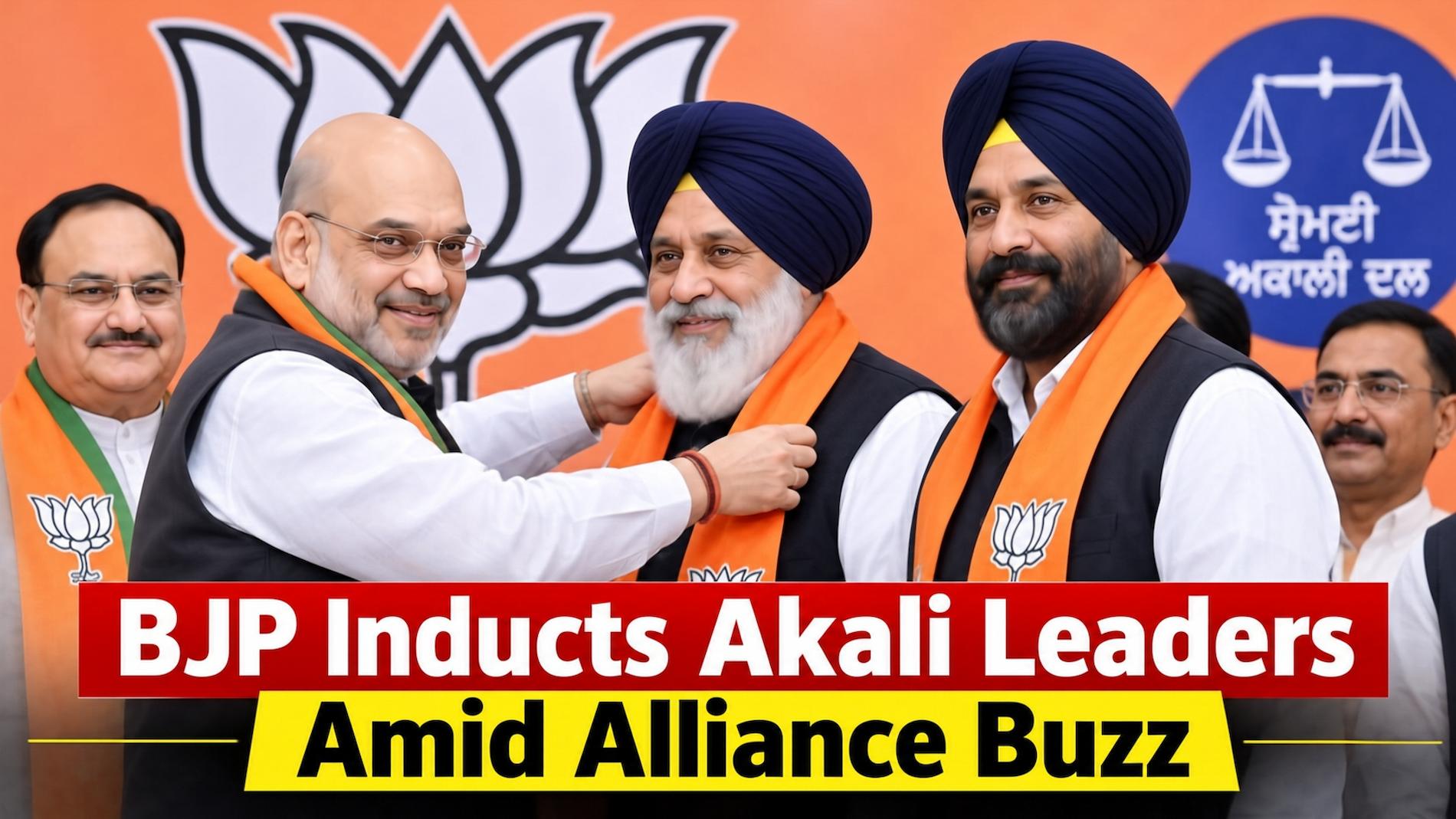
The BJP inducts Akali Dal leaders development has created fresh political discussion in Punjab, particularly because it comes at a time when speculation about a possible reunion between the Bharatiya Janata Party and Shiromani Akali Dal is gaining momentum. On November 19, 2026, the BJP welcomed prominent leaders from SAD, the Aam Aadmi Party (AAP), and Congress at a joining ceremony in Chandigarh.
The event was attended by Haryana Chief Minister Nayab Singh Saini and Punjab BJP president Kewal Singh Dhillon. Among the notable entrants were Surinder Singh Chauhan and Dr. Jaswinderpal Sohal, both associated with the Shiromani Akali Dal.
The timing has raised an important political question: Is the BJP strengthening its independent organization before negotiating an alliance, or preparing to contest the Punjab Assembly elections 2027 with a larger share of constituencies?
The development is particularly significant because BJP and SAD were long-standing political partners before their relationship ended in September 2020. Although discussions about restoring the partnership have reportedly progressed, the induction of senior Akali leaders suggests that the BJP is continuing to build its own political network.
Who Joined the BJP From SAD, AAP, and Congress?
The Chandigarh induction ceremony brought together political figures with backgrounds in different parties and organizational wings. Their entry could help the BJP strengthen its local connections in several Punjab districts.
Senior Shiromani Akali Dal Leaders Join BJP
Two prominent SAD functionaries attracted particular attention during the induction event.
| Leader | Previous Political Position |
|---|---|
| Surinder Singh Chauhan | SAD national vice-president, associated with Atam Nagar, Ludhiana |
| Dr. Jaswinderpal Sohal | Senior SAD functionary, reported as state general secretary, spokesperson, and core committee member |
| Ramandeep Singh Chauhan | National vice-president, Youth Akali Dal |
Surinder Singh Chauhan’s entry is important because of his association with Ludhiana’s Atam Nagar constituency, where local political networks can influence election campaigns. Dr. Jaswinderpal Sohal’s induction also attracted attention because of his previous organizational responsibilities within SAD.
Other Akali leaders reported to have joined the BJP included Davinder Singh Chauhan, Harpreet Singh Masaun, and Advocate Amarinder Pal Singh.
These developments have added to the discussion surrounding Shiromani Akali Dal leaders join BJP, especially while the two parties are reportedly exploring a possible electoral understanding.
AAP Functionaries Also Enter the BJP
The BJP’s induction drive was not limited to former Akali leaders. Several AAP functionaries, particularly from Moga, also joined the party.
| Leader | Previous AAP Position |
|---|---|
| Navdeep Singh Sangha | Party spokesperson and senior functionary |
| Mandeep Singh Gill | Moga Intellectual Wing in-charge and founding member |
| Manpreet Singh Rinku | Moga district president, SC-BC Wing |
| Sukhdeep Singh Dhami | Punjab joint secretary, SC-BC Wing |
The entry of these functionaries allows the BJP to attract political workers with existing organizational experience.
The AAP leaders join BJP Punjab development could also put additional pressure on the ruling party to retain its district-level leadership and strengthen its local organizational structure.
Congress Background: Student and Political Leaders
Hardik Nain, former president of the Panjab University National Students’ Union of India (NSUI), also joined the BJP. He had been associated with student politics and founded the Student Front PU.
Separately, former Congress MLA Hardial Singh Kamboj, a two-time legislator from Rajpura and co-chairperson of the party’s 2027 manifesto committee, was also reported to have joined the BJP on November 19.
These entries add another dimension to the BJP’s expansion efforts, bringing in individuals with experience in student politics as well as electoral politics.
The reported Congress leaders joining the BJP in Punjab could become significant if the party succeeds in converting these individual entries into stronger constituency-level support.
BJP’s Punjab Strategy: Building an Independent Political Base
The induction drive has wider implications for the BJP’s future in Punjab. Unlike Haryana, where the party has a strong independent political position, the BJP has traditionally depended on its alliance with SAD to improve its electoral reach in rural Punjab.
The latest developments suggest that the party wants to strengthen its own organization before entering any possible seat-sharing negotiations.
Is BJP Preparing to Contest All 117 Seats?
Punjab has 117 Assembly constituencies. The BJP’s traditional arrangement with SAD allowed it to contest 23 seats, while the Akali Dal contested the remaining 94.
However, the political situation has changed since 2020. The BJP has been working to expand its presence beyond its traditional urban constituencies by bringing influential local leaders, former office-bearers, and political workers into its organization.
The BJP Punjab political strategy appears to involve two parallel objectives:
- Build an independent organizational network capable of contesting a larger number of constituencies.
- Maintain the possibility of an electoral understanding with SAD to combine their respective political strengths.
The entry of leaders from different parties could help the BJP establish contacts in areas where it previously had a relatively limited organizational presence.
Nayab Singh Saini’s Punjab Visit and Political Attack on AAP
The presence of Haryana Chief Minister Nayab Singh Saini Punjab visit at the Chandigarh induction ceremony gave the event additional political significance. Saini criticized the Bhagwant Mann-led AAP government over debt, recruitment controversies, drug-related concerns, and alleged corruption.
According to his claims, Punjab’s outstanding debt increased from approximately ₹2.73 lakh crore in 2022, when AAP formed the government, to ₹4.47 lakh crore.
These figures and criticisms were presented by Saini as part of his political attack on the state government and should not be treated as independently verified findings in this article.
He also criticized Congress and AAP over their election promises and expressed confidence that the BJP could form the next government in Punjab.
Kewal Singh Dhillon Signals More Political Inductions
Punjab BJP president Kewal Singh Dhillon BJP also highlighted the importance of the latest joining ceremony. He described the new inductions as a “trailer,” suggesting that more political entrants and organizational developments could follow.
Other senior BJP leaders present included:
- Vijay Sampla, former Punjab BJP president.
- Paramdeep Singh Gill, former Punjab Director General of Police and BJP leader.
- Harjot Singh Kamal, former MLA and BJP leader.
- Vineet Joshi, Punjab BJP media cell chief.
Their presence indicated that the induction was being presented as part of a broader state-level organizational expansion effort.
BJP-SAD Alliance 2027: Will Sukhbir Badal Agree?
The most interesting aspect of the latest political developments is their timing. Reports of renewed discussions between BJP and SAD have emerged just as the BJP is attracting senior Akali leaders into its own organization.
The BJP Akali Dal alliance 2027 discussion gained fresh momentum after Prime Minister Narendra Modi and SAD president Sukhbir Singh Badal met in Parliament in August 2026. Their interaction on August 7 was widely discussed as a possible sign of improving political relations, although neither party confirmed an alliance at that stage.
On November 12, reports indicated that discussions had reached an advanced stage, with both parties considering a possible announcement within November. Seat sharing for the 117-member Assembly remained a central issue.
Why the 2020 Breakup Still Matters
BJP and SAD had maintained a political alliance for approximately 24 years before their separation in September 2020.
The disagreement centered on the three farm laws introduced by the Central Government. SAD eventually withdrew from the BJP-led National Democratic Alliance, ending a partnership that had shaped Punjab’s electoral politics for decades.
Their previous Assembly seat-sharing formula was:
| Party | Assembly Seats |
|---|---|
| BJP | 23 |
| Shiromani Akali Dal | 94 |
| Total | 117 |
A possible reunion will require both parties to reconsider their political expectations. BJP may seek a larger share of seats, while SAD could want to protect its traditional rural influence and political leadership.
The question of whether Sukhbir Singh Badal BJP alliance discussions can produce an agreement will depend heavily on these negotiations.
BJP and SAD Seat-Sharing Talks: What Do Election Figures Reveal?
The electoral data from the 2019 and 2024 Lok Sabha elections provides useful context for understanding why both parties may consider a reunion.
| Election | BJP Vote Share | SAD Vote Share | Combined |
|---|---|---|---|
| 2019 Lok Sabha | 9.63% | 27.45% | 37.08% |
| 2024 Lok Sabha | 18.56% | 13.42% | 31.98% |
Source: Election data reported in contemporary political coverage. These are Lok Sabha vote shares, not Assembly election results.
In the 2024 Lok Sabha elections, Punjab’s 13 seats were distributed as follows:
- Congress: 7 seats.
- AAP: 3 seats.
- SAD: 1 seat.
- BJP: 0 seats.
The BJP increased its vote share considerably between the two elections but failed to win a seat in 2024. SAD, meanwhile, experienced a substantial decline in its vote share and won only one parliamentary constituency.
The combined vote share of the two former allies declined from 37.08% to 31.98%. Although these figures cannot predict the outcome of an Assembly election, they demonstrate why discussions about cooperation have returned.
The latest BJP SAD seat sharing talks could therefore determine whether the parties contest together or pursue separate electoral strategies.
Could New Inductions Complicate an Alliance?
The entry of senior Akali functionaries into BJP raises questions about constituency-level influence and the distribution of electoral opportunities.
For example, the entry of Surinder Singh Chauhan BJP supporter and local political worker, could strengthen the party’s presence around Ludhiana. Similarly, the development surrounding Jaswinderpal Sohal joins BJP has drawn attention because of his previous organizational responsibilities in SAD.
If the parties eventually agree to an alliance, they will need to address potential differences over candidates, constituencies, and leadership responsibilities.
The Punjab election alliance news will therefore remain important in the coming days, particularly as both organizations assess their respective strengths.
What Could These Developments Mean for Punjab Politics?
The latest Punjab political developments 2026 could influence the electoral calculations of all three major political parties.
For BJP, the immediate objective appears to be organizational expansion and the attraction of established political figures. For SAD, the challenge will be to retain its traditional political influence while considering a possible partnership with its former ally.
AAP, which currently governs Punjab under Chief Minister Bhagwant Mann, will have to respond to the BJP’s efforts to attract its organizational functionaries. Congress will also be watching these developments as it prepares for another Assembly contest.
The larger question is whether the BJP wants to negotiate with SAD from a stronger position or build an independent political alternative.
The BJP expansion in Punjab could also change the bargaining position of both parties if alliance negotiations continue.
Ultimately, the BJP inducts Akali Dal leaders development highlights a political situation in which organizational expansion and alliance negotiations are taking place simultaneously.
The Road to 2027
Punjab’s political contest is entering an important phase as parties assess their organizational strengths and electoral options. The latest inductions could influence local political equations, while discussions between former allies may determine the shape of a future partnership. Seat distribution, leadership expectations, and voter support will remain central considerations. Whether the parties reunite or contest separately, their decisions in the coming months will influence the state’s political landscape and establish the groundwork for the next Assembly election.