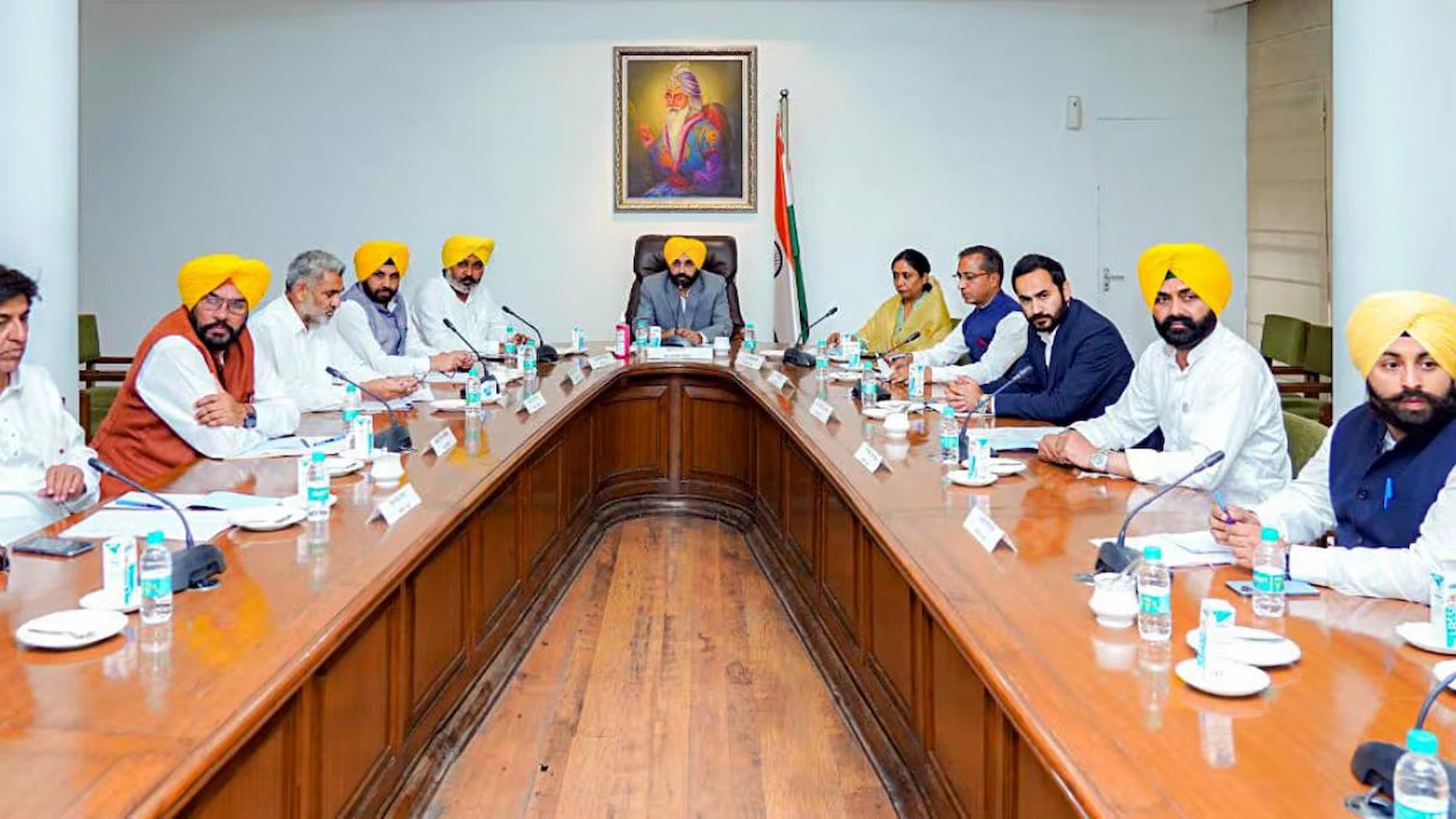
Chandigarh, July 31, 2025 – The Punjab Cabinet Meeting 2025, led by Chief Minister Bhagwant Mann, unveiled a slate of major reforms aimed at reshaping the state’s governance landscape. In a session marked by high expectations and political intensity, the cabinet approved decisions spanning education, employment, environmental sustainability, and agriculture—indicating a decisive shift toward policy-driven governance.
Held at the Punjab Civil Secretariat in Chandigarh, the meeting drew wide attention from media, opposition parties, and policy analysts. At the centre of this political moment were the CM Bhagwant Mann latest decisions, positioning the Aam Aadmi Party (AAP) government as proactive, reform-oriented, and responsive to public needs. These decisions, observers noted, come at a critical juncture as the state faces challenges in economic management, employment, and agrarian distress.
This article delves into the Punjab cabinet news today, explores the reasoning behind each policy move, highlights reactions from stakeholders, and reflects on the broader political and economic implications for the state.
Backdrop: Reform in Motion Amid Public Expectations
Since assuming office in 2022, CM Bhagwant Mann has consistently highlighted transparency, grassroots development, and improved governance as key priorities. However, midterm evaluations revealed mixed outcomes. Infrastructure lags, farmer dissatisfaction, and rising unemployment forced the administration to shift gears.
The Cabinet meeting highlights Punjab political developments under pressure—and opportunity. With less than two years before the next state assembly elections, this meeting appears to be both a governance recalibration and a political reaffirmation of the AAP’s agenda in Punjab.
Key Announcements from the Punjab Cabinet Meeting 2025
1. Free Power Scheme Extended
Chief Minister Mann reaffirmed one of his government’s most prominent promises—300 units of free electricity per month. The scheme, which has already benefited over 87% of domestic households, has now been extended until March 2026. “The people gave us this mandate for relief, and we’re delivering consistently,” said the CM at a press conference.
The extension, while welcomed by many, also invites questions about fiscal sustainability. According to the Finance Ministry, the subsidy will be supported through increased GST collections and budget rationalisation.
2. Boost to Public Education: ‘Schools of Eminence’ Expansion
In a landmark move for education reform, the cabinet approved the establishment of 127 additional “Schools of Eminence” across Punjab. Designed to provide high-quality public education, these institutions will offer smart classrooms, modern labs, multilingual instruction, and dedicated career counselling centres.
“This is not just an investment in infrastructure, but in the dreams of Punjab’s children,” said Education Minister Harjot Singh Bains. This initiative, part of the Punjab government new policies, aims to bridge the urban-rural education gap and improve academic outcomes across all districts.
3. New Crop Insurance Scheme for Farmers
Punjab’s farmers have long demanded a dependable safety net for unpredictable weather and crop losses. Responding to this, the cabinet launched a comprehensive crop insurance scheme to be rolled out starting with the Kharif season.
The scheme features:
-
Government-funded premiums up to 70%
-
Quick, weather-triggered claim settlements
-
Full coverage for registered small and marginal farmers
Farmer unions cautiously welcomed the announcement. Bhartiya Kisan Union (Ekta Ugrahan) spokesperson Harjeet Singh noted, “The scheme has potential, but implementation will be the true test.”
This development aligns with growing concerns over climate impacts and falling farm incomes and is seen as one of the key Bhagwant Mann political announcements of the year.
4. Green Punjab Mission: Climate Resilience on the Agenda
The cabinet formally approved the Green Punjab Mission, a state-level action plan to combat environmental degradation and promote sustainable development. The mission’s ambitious goals include:
-
Planting 2 crore trees in 2025
-
Expanding solar energy infrastructure in schools and government buildings
-
Incentives for rural solar installations
The CM acknowledged Punjab’s air and water pollution crisis, particularly in industrial belts like Ludhiana and Mandi Gobindgarh. “This mission is not optional. It’s existential,” he said during the press briefing.
The environmental initiative is seen as an important shift from traditional populist policy-making to long-term sustainable planning, placing climate action firmly within the state’s political agenda.
5. Creation of 12,000 Government Jobs
To address unemployment and improve service delivery, the cabinet sanctioned 12,000 new government posts, primarily in health, education, and sanitation departments. These include:
-
4,000 new school teachers
-
2,500 healthcare professionals
-
5,500 support staff across sectors
The recruitment process is expected to begin in August under the Punjab Public Service Commission.
Employment remains a top concern for voters, and this move is part of the political developments in Punjab where job creation is expected to play a major role in future electoral narratives.
Stakeholder Perspectives: Praise, Skepticism, and Caution
Reactions to the cabinet decisions have been swift and varied.
AAP supporters and government officials praised the reforms as people-centric and visionary. Political analyst Dr. Anurag Walia stated:
“This cabinet meeting signals the Mann government’s seriousness about governance. It moves beyond optics and into implementation territory.”
Farmer groups, while appreciative of the insurance plan, called for clearer policy documents and eligibility guidelines. “We’ve seen announcements before. Let’s see action,” said BKU member Rajbir Singh from Bathinda.
Opposition parties, however, remain critical. Congress leader Charanjit Singh Channi described the announcements as “headline politics”. “These are recycled promises with little budgetary backing,” he claimed. The Shiromani Akali Dal also demanded greater transparency and auditing of ongoing schemes before announcing new ones.
Political and Economic Implications
The Punjab cabinet meeting 2025 is being interpreted as a strategic pivot by CM Mann’s administration—a reset that positions the government as reformist and proactive. With elections nearing in early 2027, these decisions are expected to shape both public perception and political debates.
From an economic standpoint, analysts point to two major concerns:
-
Fiscal Pressure – The expanded welfare and recruitment schemes may stretch state finances. Punjab’s debt-to-GSDP ratio remains high, and managing subsidy costs without increasing the debt burden will be a key challenge.
-
Administrative Execution – The real impact of these decisions hinges on timely and transparent execution. Past delays in infrastructure and healthcare recruitment underscore the need for improved bureaucratic accountability.
Nevertheless, the CM’s political narrative is gaining traction: A responsive government delivering tangible benefits while building long-term systems.
Conclusion: A Defining Moment for Punjab’s Political Trajectory
The Punjab cabinet news today marks a critical juncture for the AAP-led government. The combination of welfare continuity (free electricity), systemic reform (education and employment), and forward-looking policy (environment and agriculture) reflects a balanced strategy to address both immediate needs and future challenges.
If executed efficiently, these Bhagwant Mann political announcements could transform public service delivery, revive voter confidence, and strengthen the CM’s leadership credentials ahead of the next electoral cycle. On the other hand, implementation delays or fiscal mismanagement could weaken the government’s reformist image.
As Punjab navigates the complexities of economic development, social equity, and political competition, the July 2025 cabinet meeting may well be remembered as a defining moment in the Mann administration’s legacy.